
Artificial intelligence is not just another digital tool in healthcare. It is quietly becoming the first place patients go when something feels off, when they receive a diagnosis, or when they are trying to decide what to do next.
That shift is changing everything.
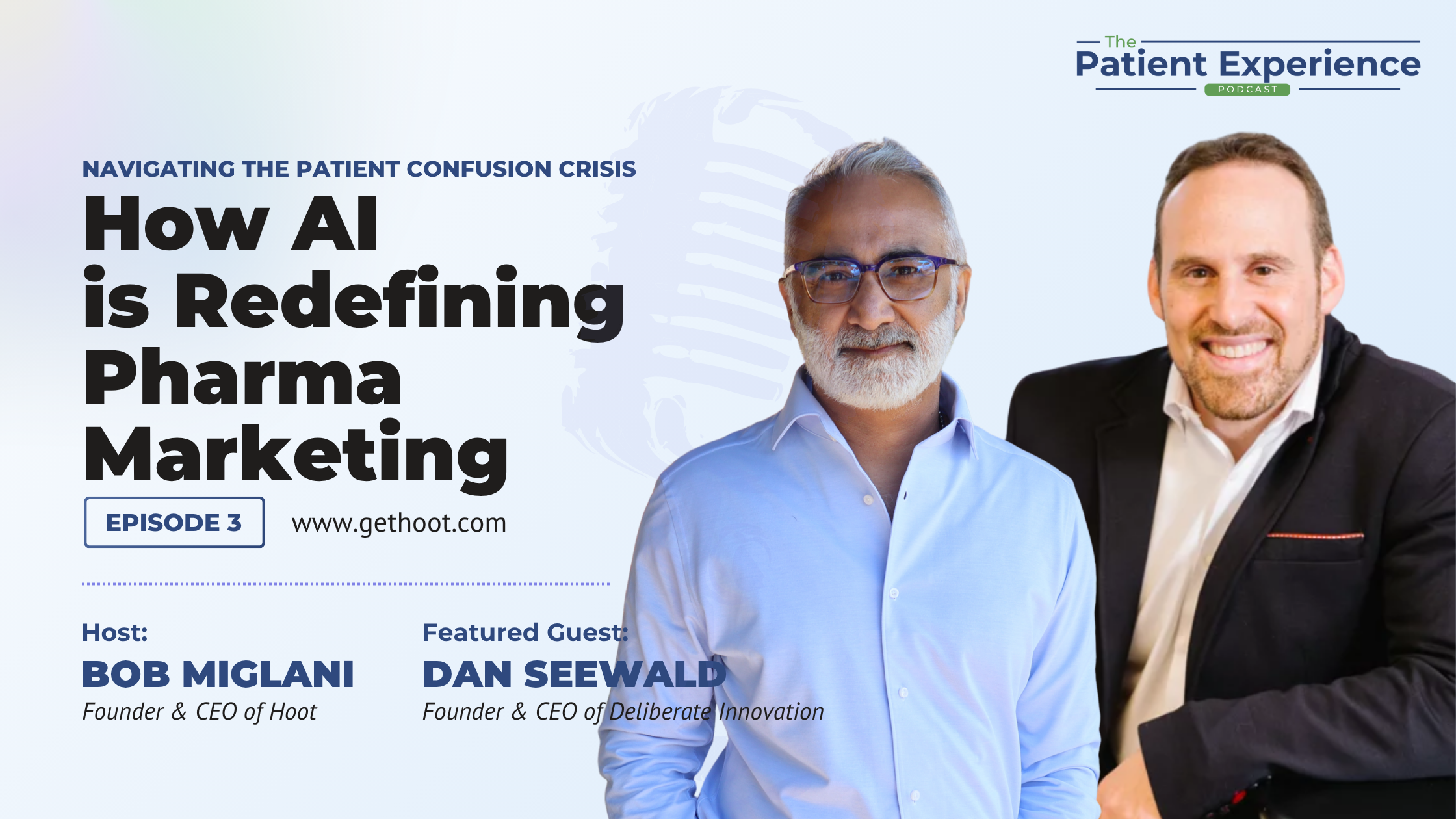
In Episode 3 of The Patient Experience Podcast, Bob Miglani and Dan Seewald unpack what this really means for pharma. Not in theory, but in terms of how patients actually behave today. And the reality is simple but uncomfortable: patients are no longer waiting for pharma or physicians to guide them. They are guiding themselves first.
The First Conversation Is No Longer with the Doctor
There was a time when the patient journey started in the exam room. Symptoms led to a visit, and that visit led to understanding.
Now, the first conversation often happens somewhere else entirely.
Patients are opening AI tools and typing in questions about symptoms, conditions, and treatments before they ever schedule an appointment. They are trying to make sense of what is happening in real time, on their own terms. By the time they sit down with a physician, they are not hearing information for the first time. They are reacting to it, comparing it, sometimes even challenging it.
That changes the tone of the entire interaction.
Instead of being introduced to a diagnosis, patients are trying to validate or disprove what they already believe. And that belief is increasingly shaped by AI.
The Illusion of Being Informed
On the surface, this looks like progress. Patients are more engaged. They are asking better questions. They are taking a more active role in their care.
But underneath that is something more complicated.
AI has made information easier to access, but it has not made it easier to understand. Patients are getting answers quickly, often in simplified language, but those answers are not always tailored to their specific situation. They lack context. They lack nuance.
And that leads to a subtle but important shift. Patients feel informed, but they are not always confident.
You see it in behaviors that pharma knows all too well:
- Delays in starting therapy
- Increased back-and-forth before decisions are made
- A need for multiple confirmations before moving forward
This is not because patients don’t care. It is because they are trying to reconcile too many inputs without a clear anchor.
Trust Is No Longer a Given
For decades, trust in healthcare was relatively straightforward. The physician was the primary source of truth, and most decisions flowed from that relationship.
That clarity is gone.
Today, trust is fragmented. Patients are pulling from multiple sources at once. AI, social platforms, peer experiences, and family input all play a role in shaping how they think about their condition and their options.
AI, in particular, introduces an interesting tension. It feels reliable because it is immediate and structured. But it is also impersonal. There is no face behind it, no accountability, no relationship.
So patients are left in a loop. They trust the speed, but they question the substance. They gather more information, but they feel less certain about what to do next.
Pharma Can No Longer Rely on the Old Model
This is where the implications for pharma become very real.
The traditional model has always been built around educating healthcare professionals first, with the assumption that information would flow naturally from physician to patient. But when patients are forming opinions before that interaction even happens, that model starts to break down.
Pharma is no longer entering the conversation early. In many cases, it is arriving late.
That forces a shift in mindset. Instead of thinking about messaging, pharma needs to think about guidance. Instead of focusing only on what needs to be said, it needs to focus on what patients are trying to understand.
That includes questions like:
- What is actually happening to me?
- What do these results mean in plain terms?
- What should I expect next?
If those questions are being answered by AI instead of credible healthcare sources, pharma loses influence at the most important moment.
Content Is No Longer Just Content
Another layer to this shift is how information is actually delivered.
Patients are not browsing websites the way they used to. They are asking direct questions and expecting direct answers. AI platforms are condensing large amounts of information into a single response, and that response becomes the lens through which everything else is viewed.
That has major implications.
Content now needs to do more than exist. It needs to be clear enough, structured enough, and credible enough to be surfaced in those AI-generated answers. If it is not, it effectively disappears from the patient journey.
This is where many organizations are still catching up. They are producing content, but not necessarily content that can live inside this new ecosystem.
The Misinformation Problem Gets Bigger, Not Smaller
There is also a more subtle risk building underneath all of this.
AI systems are only as strong as the data they are trained on. And that data includes a mix of high-quality medical information and less reliable, user-generated content. Forums, anecdotal experiences, and fear-driven discussions can all influence how answers are formed.
The challenge is not just that misinformation exists. It is that it can now scale quickly and be delivered in a way that feels credible.
Patients are not always able to distinguish between what is clinically validated and what is simply commonly discussed. And when everything is presented with the same level of confidence, that distinction becomes even harder.
What Needs to Change
For pharma leaders, patient services teams, and marketers, this is not a future problem. It is happening now.
The response does not require more volume. It requires a different approach.
Education needs to move beyond the clinic and into the environments where patients are actually making decisions. That often means at home, in conversation with family, or through digital tools that they trust and use regularly.
It also means shifting how information is delivered. Instead of long, complex explanations, patients need clarity. They need information that helps them move forward, not information that adds to their uncertainty.
A few priorities stand out:
- Make complex conditions easier to understand, not more detailed
- Focus on answering real patient questions, not just delivering brand messages
- Create experiences that feel responsive and relevant, not static
At its core, this is about meeting patients where they are, not where the system expects them to be.
A Different Kind of Patient Experience
What is emerging is a new layer in the patient journey. One that sits between the patient and every traditional touchpoint in healthcare.
AI is becoming the place where patients start, the place where they go when they are unsure, and the place where they return when they need reassurance. It is not replacing physicians or pharma, but it is shaping how both are perceived.
That changes the role of everyone involved.
Pharma is no longer just a source of information. It has the opportunity to become a source of clarity in an environment that is increasingly noisy.
The organizations that recognize this shift early will have a distinct advantage. They will be able to support patients more effectively, reduce hesitation, and build stronger, more trusted relationships over time.
And in a world where patients are already searching for answers, the real question becomes: will those answers come from you, or from somewhere else?