
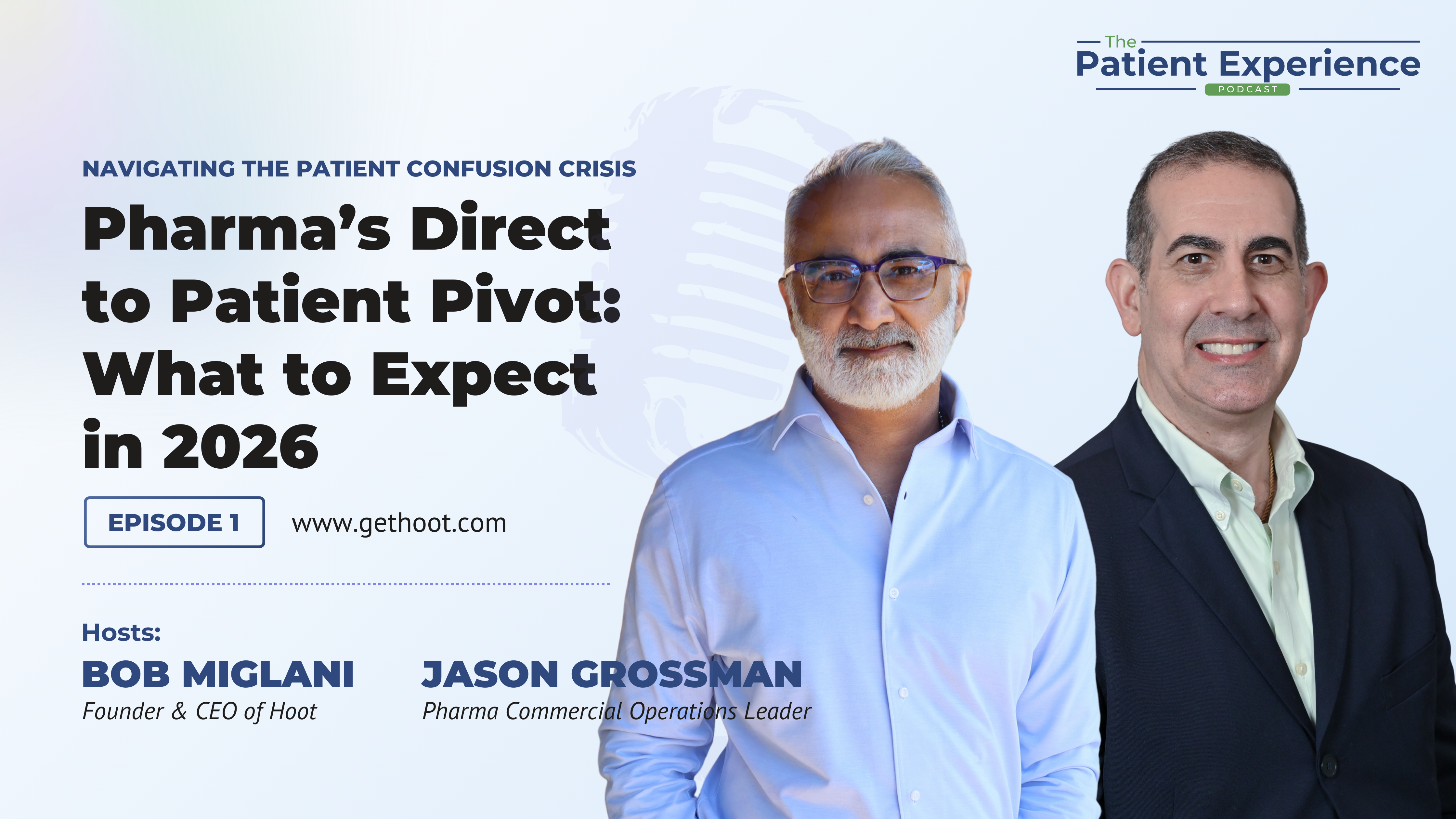
Listen to Episode 1: Pharma’s Direct to Patient Pivot: What to Expect in 2026 here.
The pharmaceutical industry is moving faster than patients can keep up.
Therapies are becoming more specialized. Disease education is more complex. Access models are shifting Direct to Patient. At the same time, physician time is shrinking and patients are being left to piece together critical decisions on their own.
Patient services teams are now expected to solve problems that did not exist at this scale even five years ago.
We launched The Patient Experience Podcast because this moment needs a clearer conversation.
The Gap No One Is Talking About
Across Pharma, patient services has become the connective tissue between innovation and outcomes. Yet the system it operates in is increasingly fragmented.
Patients receive life-changing diagnoses in short appointments. They hear clinical language they do not fully understand. They leave with more questions than answers and are expected to navigate testing, specialty pharmacies, financial pathways, and long-term treatment decisions almost immediately.
When they get home, decisions shift out of the clinic and into everyday life. Family members weigh in. Online searches escalate confusion. AI tools and social platforms deliver information without context or clinical grounding.
This is not a failure of patients or physicians. It is a structural problem.
And it is showing up everywhere in the data: delayed therapy starts, early abandonment, declining adherence, and erosion of trust.
What This Podcast Is Designed to Do
The Patient Experience Podcast exists to help Pharma leaders and patient-facing teams navigate this reality with clarity.
This is not a marketing podcast or a sales podcast. It is a working conversation about how patient services, education, access, and trust are evolving as Pharma moves Direct to Patient.
Hosted by Jason Grossman, a 25-year pharma executive across commercial operations, patient services, and marketing, and Bob Miglani, former Pfizer leader and CEO of Hoot, the podcast draws from decades inside the system.
The focus is practical. We talk about what is actually breaking, why traditional approaches are no longer sufficient, and what leaders can do differently as complexity continues to rise.
Why This Matters Now
The Direct to Patient shift is not theoretical. It is already happening.
What began with lifestyle categories is expanding into specialty and life-saving therapies. As this acceleration continues, the distance between treatment availability and patient understanding is growing.
Access alone does not solve confusion. Financial support alone does not drive adherence. Technology alone does not build trust.
Patient services teams are increasingly responsible for what happens after diagnosis, after prescription, and after the patient leaves the clinic. That responsibility requires new thinking, better education models, and a deeper understanding of how patients actually make decisions.
Episode 1 as a Starting Point
The first episode, “Pharma’s Direct to Patient Pivot: What to Expect in 2026,” sets the foundation for the conversations ahead.
In that episode, we explore why Direct to Patient models are accelerating, how specialization is reshaping patient experiences, and why confusion has become one of the biggest hidden risks in modern healthcare.
Rather than offering surface-level predictions, the discussion focuses on the real-world implications for patient services leaders, brand teams, and patient-facing organizations preparing for what comes next.
What You Can Expect Going Forward
Future episodes will continue to examine how patient services must evolve in a Direct to Patient world, with a consistent emphasis on education, trust, and real-world execution.
This podcast is meant to be useful. It is for the leaders and teams who are trying to do the right thing for patients inside a system that is becoming harder to navigate.
If patient confusion, adherence, access, and trust are part of your world, this podcast was built for you.
New episodes are recorded live on Bob Miglani’s LinkedIn and published across major podcast platforms.