You built the treatment. Now get patients to actually start it.
The rare disease pipeline is the most exciting in pharma. But approval is only half the battle. Every day a diagnosed patient does not initiate therapy is a day your drug is not working, and a day your patient is suffering.
The diagnosis is not
the end of the journey.
It's the beginning of a new one.
Rare disease patients arrive at your therapy exhausted, skeptical, and confused. They've been dismissed by doctors, given wrong answers, and have often spent years advocating for themselves. When a treatment finally exists, they don't know what to do next.
The clinical trial showed the drug works. But the clinical trial also had highly engaged, closely monitored patients. Real-world initiation is a completely different challenge, one that pharma's patient services programs are poorly equipped to solve alone.
up from 15% three decades ago
correct diagnosis
one misdiagnosis
even after diagnosis
Rare diseases affect multiple organ systems. No single specialist sees the full picture. Years pass in confusion, often with disabling symptoms and no clear name.
Avg. 4–8 years before diagnosisMore than a third of rare disease patients receive at least one incorrect diagnosis. Treatments that don't work. Side effects that shouldn't have happened. Deep distrust of the medical system takes root.
36% misdiagnosed at least onceRelief. Exhaustion. Fear. Now the patient must understand a rare condition that even many doctors don't fully know, navigate insurance and prior auth, and make a high-stakes treatment decision, often alone.
Most receive no coordinated patient education
The patient goes home.
Then nothing.
After years of fighting for a diagnosis, patients finally have a treatment available to them. But the healthcare system hands them a prescription and assumes the rest will follow. It doesn't. Without coordinated, physician-led education delivered at the right moment, confusion fills the silence and patients don't start.
Most rare disease patients receive no coordinated patient education after diagnosis
Non-clinical barriers like confusion, fear, and cost anxiety are the leading cause of treatment non-initiation
Prior authorization windows lapse, patients self-research unreliable sources, and your therapy loses its window
Six reasons rare disease patients
don't initiate, even when they should
These aren't clinical failures. They're communication failures. And they're costing your therapy its most critical metric.
After years of being wrong, patients are hypervigilant about new treatments. They've been burned before. Without an authoritative, trustworthy educational voice, fear wins over action.
"Will this actually help? Or will I just be hurt again?"
Patients are handed prescribing information, insurance forms, PA requirements, and specialty pharmacy instructions all at once. Cognitive overload leads to inaction, not bad intent.
"I don't even know where to start."
Rare disease therapies often involve infusions, injections, or specialized delivery requirements. Patients and caregivers need to be shown, not just told, what treatment actually looks like day to day.
"I've never had to inject anything before in my life."
Rare disease expertise is concentrated in academic centers and urban hubs. Many diagnosed patients live hours from their prescribing physician, creating logistical barriers that silence grows in the space between appointments.
"My doctor is 3 hours away. I can't just call."
High-cost rare disease therapies trigger sticker shock even when patient assistance programs exist. Without proactive, physician-framed education on support options, cost confusion kills initiation before it starts.
"There's no way I can afford this, even with insurance."
The moments right after diagnosis, before the first infusion and before the first injection, are when patients need education most. Yet most receive nothing. No touchpoint. No guidance. Just silence.
"I left the office and didn't know what I was supposed to do next."<
Every day of non-initiation is a cost
to your patient and to your program
It's not just revenue. It's outcomes. It's real-world data. It's the long-term evidence base that your therapy needs to thrive in a competitive rare disease market.
Confusion stalls initiation. Silence drives abandonment.
When patients don’t start on time, or don’t start at all, the consequences compound fast.
- Disease progression accelerates without treatment
- Prior authorization windows lapse without patient action
- Hospital admissions increase among non-adherent patients
- Patients turn to unvetted online communities for guidance
- PSP nurse call volume spikes with preventable questions
- Real-world evidence is weak, threatening payer negotiations
- Competitors earn word-of-mouth in your therapy area
Physician-led education at exactly the right moment.
Hoot delivers your physician’s voice, automated, personalized, and timed, directly to the patient’s phone.
- Patients receive disease education before their first appointment
- Complex administration explained via short video, not pamphlets
- Cost support programs explained in the physician’s own voice
- Patients arrive at infusion centers prepared and confident
- PSP call center volume drops for routine questions
- Non-clinical discontinuation rates fall measurably
- Real-world adherence data strengthens formulary position
Doctor Video-Based Patient Education At Every Critical
Decision Point in the Treatment Journey
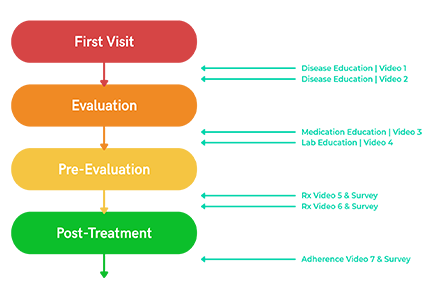
Hoot creates physician-led video education so patients get educated by their own doctor at every step, from diagnosis through long-term adherence. Doctor-delivered education via SMS that drives understanding, treatment initiation, and commitment.
Hoot Video 1: Disease awareness, why treatment matters, what happens if untreated. Patient understands their condition and feels less confused.
Hoot Video Series 2: How treatment works, expected benefits, common concerns addressed. Patient understands their options and experiences reduced confusion and fear.
Hoot Video Series 3: Personal message from physician, empathetic nudge, clear encouragement. Increased confidence, higher intent to initiate.
Hoot Video Series 4: What to expect when starting, side effects, when results typically appear. Recaptures stalled patients, reduces early drop-off.
Hoot Adherence Series: Periodic physician check-ins, reinforces value of staying on treatment, short surveys, symptom check-ins. Improved persistence, sustained outcomes.
Complete Patient Education Platform & Service

Co-Design the Patient Journey
We map every critical decision point in your rare disease patient's journey, design the messaging strategy, and build education sequences around the therapies you offer, so the right content reaches patients at exactly the moment hesitation is highest.
Create Physician Video Content
Your physician partner records via Zoom, we shoot professionally, or our AI generates content in their likeness. Every video is built around their voice and expertise, so patients hear it from their doctor, not a stranger.

Deliver, Track & Optimize
Education reaches patients within 24–48 hours via SMS and email, at every key moment: post-diagnosis, before first infusion, after first dose. Real-time analytics show open rates, video completion, and engagement so you can see what's working.
Start with a Patient Confusion Audit
In two weeks, our team will map every moment in your rare disease patient journey where confusion kills initiation and show you exactly how Hoot bridges each gap. No obligation. Just data.
For Patient Services, Market Access, and Patient Advocacy teams at pharma and biotech companies.