Pharma Commercial Operations

The Hidden Cost of
Prescription Abandonment

An educational guide for pharmaceutical commercial teams
on why patients abandon treatment and what the evidence says about preventing it.

30% of new prescriptions never filled
50% of chronic patients stop within 1 year
$637B in avoidable costs annually (US)
125K preventable deaths per year

What Is Prescription Abandonment?

Prescription abandonment occurs when a patient receives a prescription but never initiates treatment, or starts therapy and discontinues before achieving the intended clinical benefit.

Two Distinct Points of Failure

Primary non-adherence is when the prescription is never filled. Secondary non-adherence is when therapy is initiated but then discontinued prematurely. Both represent a failure to translate a prescribing decision into a clinical outcome, and both carry significant consequences for patients and manufacturers alike.

20–30%
of new prescriptions are never filled at the pharmacy
New England Journal of Medicine
50%
of patients on chronic therapies stop taking them within 12 months
WHO Global Report on Adherence
3–4x
higher hospitalization risk among patients with poor adherence
American Journal of Medicine
$300B
in lost pharmaceutical revenue attributed to non-adherence annually
IQVIA Institute

Why Patients Abandon Treatment

Abandonment is rarely intentional defiance. It is most often the result of inadequate information, unaddressed fear, or logistical barriers that could have been prevented.

Dentist & Patient Image
01
Inadequate Patient Education

Patients who leave without understanding why the therapy matters are far less likely to fill it.

02
Fear of Side Effects

Online research exposes patients to alarming anecdotes before they give the therapy a chance.

03
Out-of-Pocket Cost

Copay sticker shock at the pharmacy counter is one of the most immediate abandonment triggers.

04
Caregiver and Family Influence

Family members who weren't at the appointment often override the physician's recommendation.

05
Feeling Better Prematurely

Symptom relief leads patients to self-discontinue before therapy is complete.

The common thread across nearly all abandonment scenarios: the patient needed more information than a single office visit could deliver, at a moment when a clinician was no longer available to provide it.


What Abandonment Costs Your Brand

Industry-wide statistics make abandonment feel like someone else's problem. The math at the brand level tells a different story.

The Brand-Level Revenue Model

A specialty therapy with 50,000 annual prescriptions and a 25% primary abandonment rate loses 12,500 patients before they ever begin treatment. At an average net revenue of $8,000 per patient per year, that is $100 million in revenue that was prescribed but never realized.

Secondary abandonment compounds the loss further. If 40% of patients who do start therapy discontinue within the first six months, the lifetime value of that patient cohort drops by more than half — before factoring in the cost of patient support programs, hub services, and co-pay assistance already deployed to bring them in.

Abandonment is not a patient behavior problem. It is a brand revenue problem with a measurable intervention point.

12,500
Patients lost before first fillOn a 50K-script brand with 25% primary non-adherence — prescribed but never started.
$100M
Annual net revenue at riskAt $8K average net revenue per patient per year, before secondary discontinuation.
>50%
Lifetime value lostWhen 40% of starters discontinue within 6 months, compounding the primary abandonment loss.

What the Research Says Works

Decades of adherence research point to a consistent set of interventions that meaningfully reduce abandonment. The most effective strategies share a common characteristic: they extend the educational conversation beyond the office visit.

Journal of General Internal Medicine · Patient Education and Counseling
Finding 01

“Patients who receive education directly from their physician are significantly more likely to initiate and stay on therapy than those who receive third-party materials.”

JAMA Internal Medicine · Annals of Pharmacotherapy
Finding 02

“Proactive outreach in the first 48 hours after a prescription is written is the single highest-leverage intervention for preventing primary non-adherence.”

British Journal of Clinical Pharmacology
Finding 03

“Patients explicitly prepared for expected side effects are substantially less likely to discontinue therapy when those side effects appear.”

The Kitchen Table Moment

The Real Decision Happens at Home

A prescription is written in the office. But the decision to fill it, and stay on it, is made later that evening at the kitchen table, when a spouse asks why, a parent expresses concern, or an online search surfaces a frightening side effect profile.

The physician is no longer in the room. The pharmacist is not available. And the patient, already overwhelmed from the appointment, is navigating the most consequential moment of their treatment journey without clinical support.

Patients retain as little as 40% of what is discussed during a medical visit
Family members who were not at the appointment often drive the final decision
The window to prevent abandonment is often the first 24 to 48 hours after the visit

Complete Patient Education Platform & Service

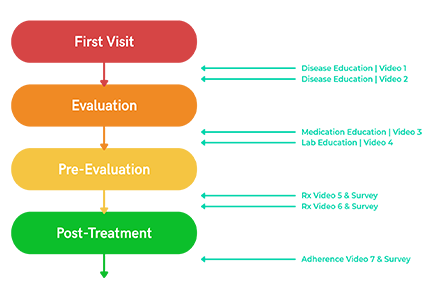
Co-Design the Patient Journey
1

Co-Design the Patient Journey

We map every critical decision point in your patient's journey, design the messaging strategy, and build education sequences around the therapies you offer, so the right content reaches patients at exactly the moment hesitation is highest.

Create Physician Video Content
2

Create Physician Video Content

You record videos on Zoom, we shoot professionally in your practice, or our AI generates content in your likeness. Every video is built around your voice and your expertise, so patients hear it from their doctor, not a stranger.

Deliver, Track & Optimize
3

Deliver, Track & Optimize

Education reaches patients within 24 to 48 hours of their prescription, via SMS and email, at every key moment. Real-time analytics show open rates, video completion, and engagement so commercial teams can see what is working.

Physician-Led Education, Delivered at Every Critical Moment
A sample of what patients receive from the moment a prescription is written through long-term adherence
Patients like you, trust you and believe you're an expert when they see you on video.
Prescription Written
SMS
SMS
First Fill
SMS
SMS
Early Adherence
SMS
Refill Window
SMS
Long-Term Adherence
SMS
Choose how to deliver:
Dr. Jonah Miller
Physician
Record Your Own Videos
AI
Dr. Jonah Miller
AI Physician
Create a Doctor Clone
AI
Leah
Patient Education Coordinator
Use Hoot's AI Agent

Want to see a patient journey built for your therapy?

Request a Demo

Ready to Reduce Abandonment for a Therapy?

Connect with the Hoot team to learn how physician-led video campaigns have been deployed across specialty and primary care therapy areas to improve starts and adherence.

Request a Demo Download the Evidence Brief