Patient access has traditionally been a function that happens after the clinical encounter. The physician prescribes, the patient leaves the office, and then a separate ecosystem of hub services, specialty pharmacies, and payer interactions kicks into gear. At Hub West 2026, leaders from Flora Health and Aquestive Therapeutics made the case that this model is fundamentally broken and that the future of patient access lies in integrating it directly into the point of care.
Why Distance from the Point of Care Kills Access
Every step that separates the prescribing moment from the access process introduces friction, and every point of friction increases the risk of patient dropout. When a patient leaves their physician’s office with a prescription for a specialty medication, they enter a process they did not ask for, do not understand, and cannot control. They wait for a call from a hub they have never heard of. They provide information they have already given to their doctor. They navigate insurance requirements they do not understand. And at each step, the motivation and clinical confidence they felt in the doctor’s office fades.
The data on first-fill abandonment tells the story: for many specialty categories, 20% to 40% of patients never fill their first prescription. The reasons are varied, but the common thread is the distance, in time, in steps, and in emotional connection, between the prescribing moment and the moment the patient has medication in hand.
EHR-Connected Workflows and Health System Integration
The most promising approach to closing this gap is integrating patient access workflows directly into the EHR and the clinical encounter. When the prescriber can initiate benefits verification, identify coverage pathways, and connect the patient with support services before the patient leaves the office, the entire access timeline compresses.
This is not a theoretical concept. EHR-connected access platforms are in production today, enabling real-time benefits verification at the point of prescribing, automated identification of the most efficient access pathway, including specialty pharmacy selection, copay program enrollment, and PA initiation, seamless data transfer from the clinical encounter to the access ecosystem, and provider-facing dashboards that show the status of each patient’s access journey.
The impact is measurable. Providers spend less time on administrative tasks. Patients experience fewer handoffs and fewer surprises. And speed to therapy, the time between prescription and first fill, improves significantly.
The Health System Shift
This evolution is accelerated by a structural change in healthcare delivery: the ongoing consolidation of physician practices into health systems. As more specialists practice within integrated delivery networks, the opportunity to embed access workflows into system-level infrastructure increases. Health systems have the IT capabilities, the payer relationships, and the operational scale to support embedded access in ways that independent practices often cannot.
For manufacturers, this means rethinking patient access strategy. Rather than building programs that sit outside the provider workflow and rely on the patient to bridge the gap, the next generation of access solutions must work within the clinical environment where the prescribing decision is made.
Physician-Led Education at the Point of Care and Beyond
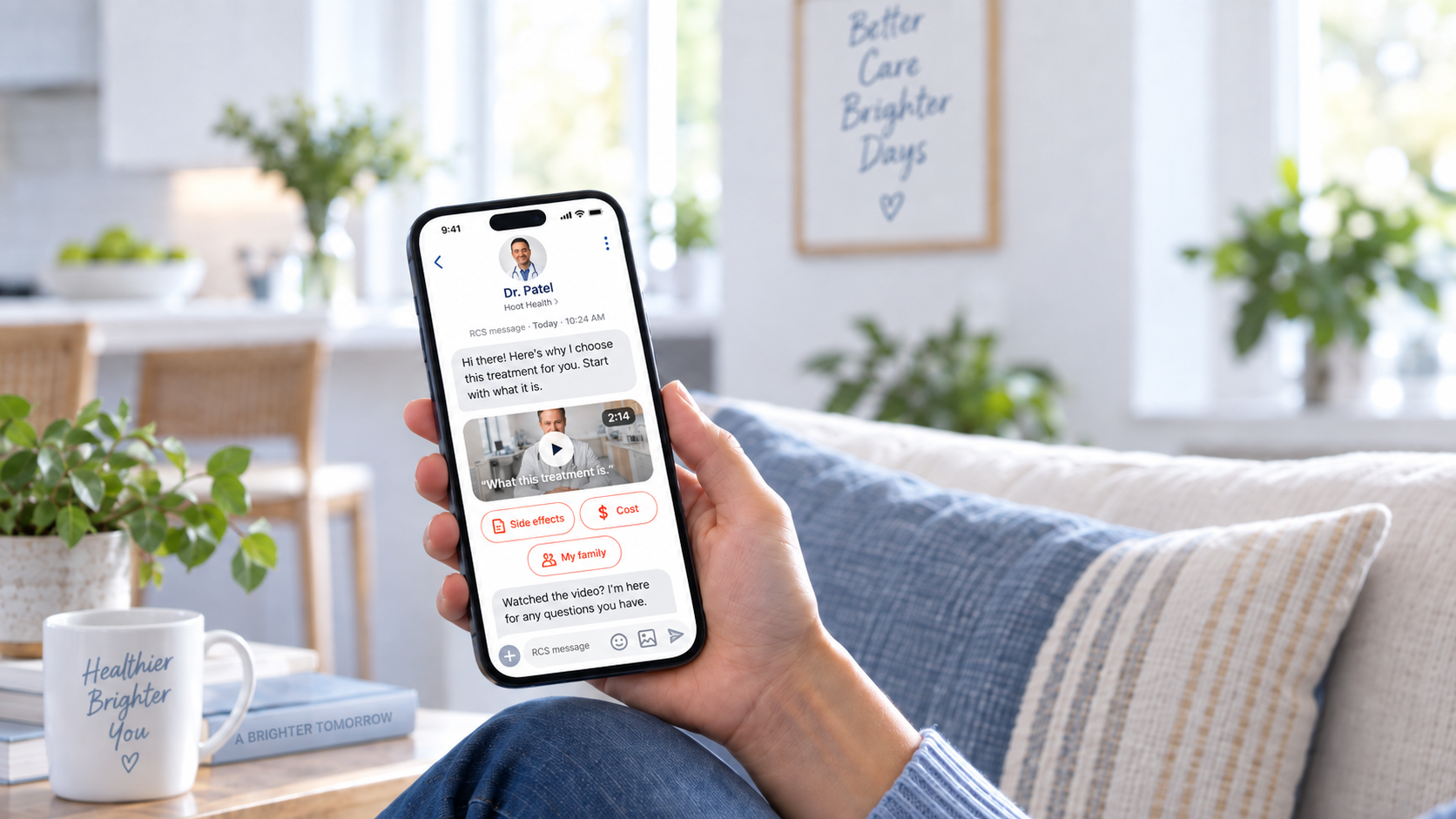
At Hoot, we solve a complementary piece of this puzzle. While EHR-connected access platforms address the operational barriers, Hoot addresses the clinical confidence gap. When a physician enrolls a patient in Hoot during the office visit, the patient begins receiving educational content from their own doctor within hours, well before the access process is complete.
This means the patient is being educated, reassured, and supported from the moment of diagnosis, not from the moment their insurance is sorted out. The physician’s voice is with them through the prior authorization process, through the specialty pharmacy onboarding, and through the first administration. This is what “closer to the point of care” means in practice: the physician’s clinical guidance travels with the patient, delivered on their phone, at every critical moment in the therapy journey.
The combination of embedded access workflows and physician-led education creates a patient experience where access is faster and confidence is higher, which is exactly the formula that reduces first-fill abandonment and improves speed to therapy.